Macbeth
Critique • Quotes • At the movies
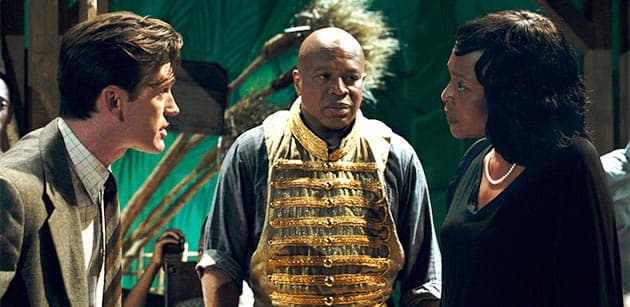
Film shows Orson Welles (left, Jewell Wilson Bridges) directing an all-Black Macbeth for stage.
Revisiting a famous stage production
Voodoo Macbeth (2021): biopic; film, 108 minutes; ten co-directors; seven writers; featuring Jewell Wilson Bridges, Inger Tudor, June Shreiner
Okay, this isn't really an adaptation of the play Macbeth. Voodoo Macbeth is a film about the making of a ground-breaking stage production of Macbeth—an all-Black production premiering in 1936.
The film is actually a student production collectively written, directed and performed as a project of the University of Southern California's School of Cinematic Arts.
The play within the film was produced by the Negro Theatre Unit of the Federal Theatre Project, a government-funded program to give work to theatre artists in the Depression era. The all- Black production was initiated by a young John Houseman, who would become an acclaimed producer, director and actor, and by the accomplished Broadway actor Rose McClendon. To direct, they brought in Orson Welles. He came up with the brilliant idea of setting Macbeth in the nineteenth-century on a Haiti-like island, turning the witches into Vodou practitioners, which gave the production its nickname of Voodoo Macbeth.
Film footage of part of 1937 stage play Macbeth. (National Film Preservation Foundation)
Welles, who was only twenty at the time, is portrayed in the film by almost-as-young actor Jewell Wilson Bridges. Bridges is actually very good if you ignore who he's supposed to be. Welles in those days was reportedly an intimidating but warm personality who dominated every room he was in. Bridges however overplays him as a self-centred, insecure, even whiny, pulling the play together out of a desperate need to prove himself.
Unfortunately, the role of Rose McClendon is diminished by the focus on Welles's genius. McClendon was a force behind the scenes to form the dream of an all-Black production and, as the planned Lady Macbeth, she was a force on stage, working closely with Welles to make the dream a reality. However, she suffered a fatal illness that forced her to withdraw. She did live long enough, though, to see the play successfully open, in part as a result of her efforts. Hers is a great dramatic arc comparable to that of Welles. In the role Inger Tudor is meant to costar with Bridges and she does play McClendon very well. But she isn't given enough screen time to have the impact she deserves.
Trailer for Voodoo Macbeth, film about the making of the 1936 Harlem stage play.
We also get only hints of the odysseys that the other Black actors were embarked on. Most of them had no stage experience whatsoever and yet found themselves after months of rehearsal turned into Shakespearean characters, delivering the bard's dialogue before thousands of people. Only a few episodes showing the struggles of members of the cast—said to number 150—are dramatized. And those struggles are presented mainly as problems for Welles to solve.
I would have liked a longer running time and fewer histrionics from Welles to delve further into how the largely amateur Black performers were affected and changed by this historic event they were drawn into.
Despite the above complaints, though, this film provides an interestingly different and engaging take on presenting a play that is considered one of Shakespeare's most difficult—even without the additional challenges accepted by the characters in Voodoo Macbeth.
— Eric
