The Witness for the Prosecution
Critique • Quotes • At the movies
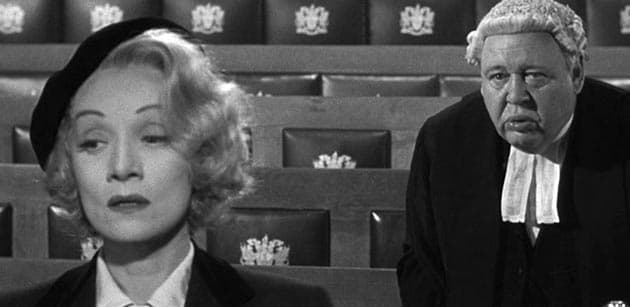
Sir Wilfrid (Charles Laughton) questions Christine (Marlene Dietrich) in 1957 film adaptation.
Staging a murderous classic
Witness for the Prosecution (1957): Film, 116 minutes; director Billy Wilder; writers Wilder, Harry Kurnitz and Larry Marcus; featuring Charles Laughton, Tyrone Power, Marlene Dietrich, Elsa Lanchester, John Williams, Norma Varden, Ruta Lee
The most revered film version of Agatha Christie's famous courtroom drama is not based on the short story, "The Witness for the Prosecution," but on Christie's own adaptation of the story for the stage.
For the theatrical Witness for the Prosecution, the author did more than drop the leading article from the title. She made major and minor changes to the story's characters, and those changes were picked up by the 1957 black-and-white film.
Christie didn't like her short story's ending in which the guilty parties apparently got away with their crime and she added a new scene at the end that punished the perpetrators. A scene that gave another double twist to an already twisting narrative.
The Billy Wilder-directed film plays the conclusion with high drama, wit and sudden violent action—capping a darkly delicious movie. Hollywood at its storytelling best.
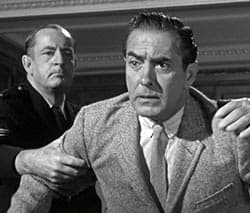
Tyrone Power as Leonard Vole.
Of course part of the movie's appeal comes from the wonderful cast, almost all of whom play characters who differ from those in the short story.
The lawyer in the spotlight throughout is no longer Mr. Mayherne but the almost completely new character of Sir Wilfrid Robarts, a prominent barrister, played by the always marvellous Charles Laughton. Mayhew (as he's renamed here) is still around as the soliticitor who brings Sir Wilfrid the case but he's a minor figure.
Laughton's spouse—and equally delightful actor Elsa Lanchester (Bride of Frankenstein)—is also brought on board for a part created by the screenwriters. Miss Plimsoll is a private nurse tending to the health of a stubborn Sir Wildrid after his recent heart attack. The tricks and banter between the two of them as they try to outwit each other bring much-needed humour to the project, lightening the early exposition and shifting the tension in later scenes.
Playing Vole's wife Christine (previously Romaine), the legendary screen siren Marlene Dietrich is brilliantly icy or vulnerable as needed. She even gets to sing, though her lieder is halted by aroused men who assault her. That scene is part of a flashback filling in the back story of Christine and Leonard meeting in postwar Germany. (That's post the Second World War, not the First as in the original story.)
Over-the-top trailer for Witness for the Prosecution (1957) movie.
As Leonard Vole, American actor Tyrone Power may have less to do than in most of his leading man roles. But the film's success turns on his likability as the seemingly innocent man, as well as his ability to portray...well, something else when suddenly required. (Incidentally, this is the 43-year-old's last completed film as he would die while shooting an action scene the following year.)
But it's the script—the wit, the deadpan humor in court, the revelation of personality through dialogue, the economical structure of scenes—that give the actors and Wilder's cameras the material to produce enthralling drama.
Most of the play takes place in a courtroom and Wilder adopts much of that staging, while opening it up to outside scenes as much as possible. He and his team keep Christie's stage mechanics but use film techniques—close-ups, reaction shots, pacing—to heighten the drama, beyond just filming a theatrical event.
It's so effective that when the film was remade in the 1980s, they followed Wilder's lead—beat by beat.
— Eric
