Miss Smilla's Feeling for Snow
Critique • Quotes
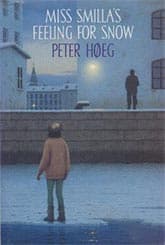 First UK edition, 1993
About the book
Author
Peter Høeg, Denmark
Also known as
Smilla's Sense of Snow
Original title
Frøken Smillas fornemmelse for sne
First publication
1992
Form
Novel
Genre
Crime, mystery, thriller
Writing language
Danish
Length
Approx. 103,000 words
The bigger mysteries
Peter Høeg's atmospheric writing in his most famous novel can make you question the genre it supposedly belongs to. It can lead you to wonder whether you should be thinking in terms of genres at all.
Miss Smilla's Feeling for Snow is a mystery that spreads far beyond its causative incident, the death of a young boy in Copenhagen, to nudge up against the deeper mysteries of science, sociology, colonialism and corporate politics.
It's a detective story without a detective at the centre. Armed only with extraordinary perceptions and intuitions, Greenland native Smilla Jasperson investigates her way through the layers of questions she runs into, aided (or opposed) by a sprawling cast of dubious figures.
It's a thriller with its share of exciting and suspenseful moments but also with more characters and character development than found in many a work of mainstream literature. Aspiring, it would seem, to cross over into literary fiction.
Not to say Miss Smilla's Feeling for Snow is a masterwork. Høeg's prose, at least in translation, is as eccentric as his first-person narrator, jumping from darkly fanciful description to cold-as-ice mathematical exposition, to sardonic commentary on Danish character flaws, to casual detailing of personal relations as bleak as the wintry landscape.
What isn't known
The result is a novel that can read more like a set of interconnected fragments of a larger story we can't quite grasp. This is especially the case in the second half of the novel as Smilla follows her investigation onto a ship, joining an Arctic expedition with enigmatic goals. She has multiple run-ins with scientists and sailors who are out to get her for unknown reasons. It is also in this latter part that the technical and scientific digressions become most tiresome and hard to follow.
Høeg also has this habit of holding back knowledge that Smilla has, sometimes something as simple as the identity of whom she's talking to, as if it should be (but isn't) obvious to the reader—and then casually dropping it in a bit later.
The novel's abrupt ending before the main characters' complete fates are known is a variation on this trick but without any room left for explanations. Many readers have complained about the lack of a satisfying resolution.
But when the writing and plotting are good, they're really good. Small wonder Miss Smilla's Feeling for Snow (known as Smilla's Sense of Snow in the U.S.) is credited for launching a popular new subgenre—that of Nordic noir.
Høeg's novel may not be the best of the Scandinavian lot, but it's hard to imagine Stieg Larsson's The Millennium Trilogy (The Girl with the Dragon Tattoo and so on) or the works of writers like Henning Mankell and Jo Nesbø without Miss Smilla first showing the way to a wider ranging, socially aware, morally dense brand of mystery narrative, crime thriller, or whatever you prefer to call it.
— Eric
Critique • Quotes
