
Silver Blaze
Critique • Quotes • Sherlock Holmes at the movies
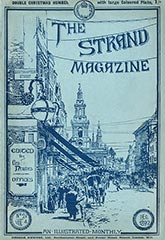 First appearance, 1892
First publication
1892 in Strand Magazine
First book publication
1893 in The Memoirs of Sherlock Holmes
Literature form
Story
Genres
Crime, mystery
Writing language
English
Author's country
England
Length
Approx. 10,000 words
Country life and death
In his story "Silver Blaze" you can see Arthur Conan Doyle getting restless with the conventions set by his Sherlock Holmes series and trying to widen the genre's scope.
Holmes and his sidekick Doctor Watson leave their familiar London to investigate a murder and the disappearance of a race horse in the countryside. Holmes seems reluctant to leave the urban environment in which his unusual talents have flourished.
The rural locale is Dartmoor in Southwest England, close to that in Doyle's later novel The Hound of the Baskervilles (1902). Some aspects of Doyle's writing here foreshadow those of the later novel.
The change of environment for the detectives gives Doyle (and the fictional narrator Watson) a chance to create a new social setting, no doubt using the research tools that served him in writing all his non-Holmes historical fictions. He could also set the scene with the kind of atmosphere found in Gothic tales of suspense. The stables where the crimes took place are remote and the lonely, neighbouring moors add to the foreboding ambience.
These elements however are not as developed as in The Hound of the Baskervilles and, after the scene is established, the story of "Silver Blaze" reverts to Holmesian puzzle-solving.
Curiouser and curiouser
This narrative can be seen as a kind of locked room mystery, if you consider the secured and guarded stable from which the horse vanished a "room". (Some have categorized this story rather as an impossible disappearance or a closed circle mystery.) All the clues leading to Holmes's solution are presented, giving readers a chance to solve the puzzle themselves.
At least two twists in the "Silver Blaze" story have become popular features—even clichés—in mystery fiction.
One is Holmes's remark on the "the curious incident of the dog in the night-time". (See Notable lines for the full passage.) Variations on this clue has appeared in tales by Agatha Christie, Erle Stanley Gardner, Ellery Queen, Mark Haddon and others.
The second one is the notion of something being hidden in plain sight, which explains how Holmes finds the missing horse. The trick wasn't invented by Doyle but he popularized it and it's been used in myriad stories, plays, movies and television shows ever since.
They may not provide the kind of literary credentials Doyle was seeking when he started writing "Silver Blaze" but they are evidence of a literary fame of sorts.
— Eric
Critique • Quotes • Sherlock Holmes at the movies
