
The Return of Sherlock Holmes
Critique • Quotes • Sherlock Holmes at the movies
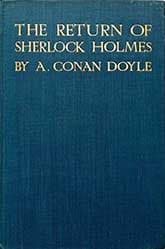 First edition
First publication
1905
Literature form
Story collection
Genres
Crime, mystery
Writing language
English
Author's country
England
Length
Thirteen stories, approx. 112,000 words
Back from the dead
Is there life after death? Or putting it differently, could a legendary literary character, killed off by his creator, recapture his former magic if he's resurrected eleven years later?
In the case of Sherlock Holmes—as evidenced in Arthur Conan Doyle's story collection The Return of Sherlock Homes (1905) and successive volumes—the answer is both "no" and "yes".
For the negative side, it can be noted that on average the stories of a revived Holmes are not quite as great as the earlier exploits that established him as the world's greatest fictional sleuth.
(We're not counting The Hound of the Baskervilles (1902) because it supposedly took place well before Sherlock's purported death.)
On the plus side, it can be noted that despite mediocre Holmes stories appearing increasingly often in later years, other stories from these collections are gems.
And the overall decline is not really more egregious than the decline in any long-running series after a pioneering start. The law of diminishing returns applies, and the best you can accomplish is to limit its effect as much as possible.
You could argue that taking a decade-long break from Holmes was actually a good thing for Doyle. It prevented his chronicling of the detective's work from getting stale sooner and allowed him to come back to the character's cases with renewed creativity.
After the final problem
Sherlock Holmes's death had been convincingly reported in "The Final Problem", the last story in The Memoirs of Sherlock Holmes collection. So the story that brought him back would have to be equalling credible. Evoking a miracle in Holmes surviving the fall that killed Moriarty wouldn't do it. Nor would having Watson waking up and realizing the death of his friend had been a dream. The recovery story would also have to explain persuasively why Holmes—for years—never revealed his continued existence to his grieving, close friend.
But somehow Doyle accomplishes this in "The Adventure of the Empty House". He doesn't rush it. He envelops the whole story of Holmes's escape and secret work inside the new story of stymieing an assassination attempt by Moriarty's lieutenant Sebastian Moran. The two-fold reveal to Watson is dramatically satisfying.
However pleasing the result is, though, it has to be admitted that the story isn't much of a mystery.
It's been said the success of this and other stories in The Return of Sherlock Holmes is that they not only brought the detective back to life but earned him immortality—in our culture at least. The fictional character became mythic hero.
Other standout entries in this collection, such as "The Norwood Builder" and "The Dancing Men", show a return to Sherlock Holmes returning to his original function as a puzzle solver.
The adventure of "Charles Augustus Milverton" features Holmes as a moralist, chasing down a blackmailer, yet not turning in a murderer, thus displaying his idea of justice being above the law.
"The Abbey Grange" is known for containing the phrase "The game is afoot", which has since been exclaimed by Holmes in many a movie and TV show as he heads out on an investigation. (However, sorry to disappoint Sherlockians but the words are not original with Arthur Conan Doyle, but with Shakespeare—from Henry IV, Part 1, to be precise.) The story is also another one in which Holmes dispenses his own sense of justice.
The long goodbyes
Near the end of The Return of Sherlock Holmes, Watson indicates once again he is discontinuing publication of his friend's exploits, this time due to Holmes's retirement.
Yet the public's and his publishers' pressure on Doyle to keep producing the wildly popular stories led eventually to another collection, His Last Bow (1917). But there's no return to a career as a private detective for Holmes. Rather, these stories are mostly presented as being retrospective accounts of Holmes's past cases and the volume sports the subtitle Some Later Reminiscences of Sherlock Holmes.
What the public and publishers of the day got with these stories though must have been a disappointment. The writing may be more mature and atmospheric. But it is also more exploratory of other genres—including gothic horror and espionage thrillers. Familiar accounts of puzzling criminal plots and their clever solutions are few and far between.
"The Devil's Foot" is one of the most successful of the moody stories, taking place in the Cornish landscape with a psychologically disturbing plot. There is a case for Holmes and Watson to work on, involving mad brothers and a dead sister, but the story is more of a literary achievement than a detection classic.
The collection's concluding story, also called "The Last Bow", actually reports on a new case for Holmes. He comes out of retirement to uncover a German spy ring on the eve of the First World War. He may no longer be the beloved detective of Victorian mysteries but his updated appearance in this story is highly regarded.
But even Holmes's "last bow" was not his last. A decade afterwards appeared the final collection of his adventures, The Case-book of Sherlock Holmes (1927). It's the least acclaimed volume, with erratic style changes and even wider departures from the crime and mystery genre than in preceding compendiums.
Still though, you can find stories worthy of the Sherlock Holmes name. "The Illustrious Client" may be the strongest, offering sensational, sexy and violent thrills along with the mystery solving.
Skilfully written, "The Sussex Vampire" seems to be heading into supernatural territory but the growing terror is undercut by Holmes's rational explanation of a mundane crime being committed.
So, at last, is this collection the end of Sherlock Holmes stories?
In the preface to this volume, the author laments:
I fear that Mr. Sherlock Holmes may become like one of those popular tenors who, having outlived their time, are still tempted to make repeated farewell bows to their indulgent audiences. This must cease and he must go the way of all flesh, material or imaginary.
But this time he really means it and he concludes:
And so, reader, farewell to Sherlock Holmes! I thank you for your past constancy, and can but hope that some return has been made in the shape of that distraction from the worries of life and stimulating change of thought which can only be found in the fairy kingdom of romance.
So that's it. This volume wraps up the last adventures of Sherlock Holmes stories. At least from the pen of Arthur Conan Doyle.
In the century to come, dozens of other writers will take up Holmes and Watson in stories, novels and other literary forms, keeping the mythology alive.
— Eric
Critique • Quotes • Sherlock Holmes at the movies
