
The Memoirs of Sherlock Holmes
Critique • Quotes • Sherlock Holmes at the movies
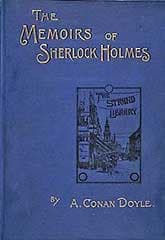 First edition
First publication
1894
Literature form
Story collection
Genres
Crime, mystery
Writing language
English
Author's country
England
Length
Twelve stories, approx. 96,000 words
The unforgettable sleuth
In the year or so after publication of his first volume of stories featuring his popular detective, The Adventures of Sherlock Holmes (1992), Arthur Conan Doyle produced two novels, a collection of short adventures, and two plays—without Sherlock Holmes. He also produced a dozen further adventures of Holmes for The Strand Magazine—enough to fill another story collection. The man was prolific.
Amazingly, The Memoirs of Sherlock Holmes (published in 1893, though dated 1894) contains stories that are among his best. Overall, only a slight fall-off in quality is detectable in the series as the author, tiring of his character, pushes him through more diverse, sometimes bizarre, mysteries.
Memoirs is often celebrated as being pivotal in the Sherlock Holmes canon, as Doyle experiments with the detective story he'd practically invented. The stories move beyond mere puzzle-solving, developing the world and characters of Holmes, and they turn toward a tragic end of the whole series. In short, they establish the Holmes oeuvre in the literary pantheon.
At least that's how many fans see it, overlooking the unevenness of the volume, which contains both the sleuth's most interesting cases and his least interesting.
Toward the last case
Among the most highly regarded though is the adventure that kicks off the collection. In "Silver Blaze" Holmes and Doctor Watson are dispatched to the countryside to investigate the disappearance of a race horse. The change of environment lets Doyle create a new atmospheric setting for his protagonists in which to investigate and the story develops differently from past episodes.
The rest of the stories don't quite come up to the standards of "Silver Blaze" but include several most cherished by readers. Also them are the dark and grisly "The Cardboard Box", the sentimental "The Yellow Face", and the piece best known for introducing Sherlock's similarly gifted elder brother Mycroft, "The Greek Interpreter".
Two other stories are of interest for showing the development of Holmes's skills in early cases and for being narrated mainly by Holmes himself, instead of by his usual chronicler Watson: "The Gloria Scott" is more of a treasure hunt than a whodunit and "The Musgrave Ritual" is an Edgar Allan Poe-style gothic thriller.
But overshadowing the entire Memoirs collection is the last story, "The Final Problem". This is the one in which Doyle kills off his protagonist. After Holmes and arch-villain Moriarty go over the Reichenbach Falls to certain death, a retrospective pall descends over all the previous stories in memory as if they had all been leading to this.
The supposedly last adventure of Sherlock Holmes provoked an angry outcry when it was first related and many readers mourned the loss of their favourite fictional character for a decade to come.
Today, of course, the impact is lessened as we read of his "death" knowing that we're less than halfway through the tales of this strange hero.
— Eric
Critique • Quotes • Sherlock Holmes at the movies
