Philip Marlowe series
Critique • At the movies
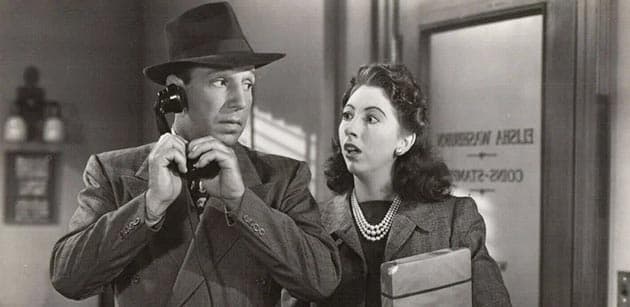
Lloyd Nolan (left) is Marlowe—er, the Falcon—in the second adaptation of a Raymond Chandler novel.
Replacing Marlowe
Time to Kill (1942): Film, 61 minutes; director Herbert Leeds; writer Clarence Upson Young; featuring Lloyd Nolan, Heather Angel, Doris Merrick, James Seay
There's no more Philip Marlowe in the second Hollywood adaptation of a Raymond Chandler novel, Time to Kill, than there was in the first. This time the private eye is named Michael Shayne to fit the movie into an existing B-movie series featuring the detective created by writer Brett Halliday, but the story is based on Chandler's The High Window (also 1942).
Lloyd Nolan, in his seventh and last turn in the series, is a good Michael Shayne—quick-witted, cocky and likable—as he skips his way toward solving the mystery. But he's no Marlowe. None of those brooding, cynical touches we expect from Chandler's "slumming angel". His world is far brighter, less corrupt, and the people are less morally ambiguous than in any real film noir.
The story is streamlined from Chandler's complex plot and subplots, which is a given for most movies and especially for one that's barely more than an hour long.
Yet, in several ways, Time to Kill is one of the more faithful adaptations of a Chandler novel, slightly more so than the later 1947 film also based on The High Window but featuring an actual Philip Marlowe.
Most of the novel's important plot elements are fit into the short film, although this requires a breakneck pace. Bodies show up inexplicably. Clues are sped past. Good and bad characters are whisked in and out of fast-moving scenes. They repeatedly get the drop on the sleuth, who quickly shakes off any effects, and gets everyone together for a penultimate scene in which he explains everything (the kind of exposition that Chandler eschewed). And, of course, there's a hopeful, happy conclusion for the detective, in place of the book's bittersweet ending.
Some of the great Chandler dialogue shows up nearly verbatim in the screenplay, though we miss Marlowe's internal musing, both the jaded assessments of the world he inhabits and the idealistic bits about his role in this dark world. No time for all that.
In short, for Chandler fans, Time to Kill makes for an enjoyable hour's viewing. But it's no substitute for the real thing.
— Eric
Critique • At the movies
1942, 1942b, 1944, 1946, 1947, 1947b, 1969, 1973, 1975, 1978, 1998, 2022
See also:
The Postman Always Rings Twice
Buy the book:
The Big Sleep; Farewell, My Lovely; The High Window (Everyman's Library)
X (Twitter):
