Anna Karenina
Critique • Quotes • Translations • At the movies
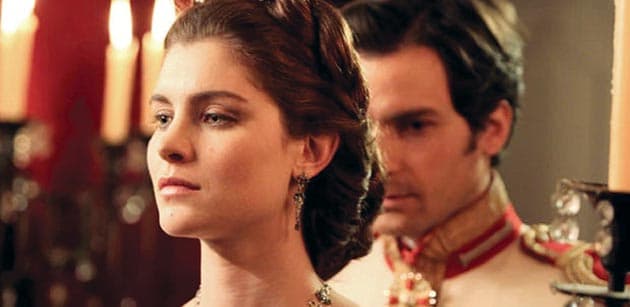
Vronsky (Santiago Cabrera) is after Anna (Vittoria Puccini) in the 2013 series of Anna Karenina.
Time for love—and more
Anna Karenina (2013): Television miniseries 218 minutes; director Christian Duguay; writer Francesco Arlanch; featuring Vittoria Puccini, Santiago Cabrera, Benjamin Sadler, Max von Thun, Lou de Laâge
Here's a good, if not great, adaptation of Anna Karenina that has slipped through the cracks for most lovers of Tolstoy's great novel. It may be found on some streaming services misfiled under the titles and descriptions of other adaptations—most likely those of Anna Karenina: Vronsky's Story, a very different television series.
Like most adaptations of Tolstoy's very long novel, the European co-production of 2013 focuses on the tragic love story of Anna and Vronsky, especially on the inner torment of of the title character. The two-and-a-half-hour length provides enough time to get into the nuances of her emotional swings as she is alienated from her husband, dotes on their child, falls in love, leaves her family, gives birth to another child, and is racked with guilt and jealousy—leading to her alienation from life itself.
Italian actress Vittoria Puccini makes an interesting titular characteer, a somewhat more natural—dare I say modern?—and less melodramatic Anna than usual, yet reaching the character's emotional peaks and painful collapses.
The character of her husband, Karenin, also benefits from greater attention. In the capable hands of Toronto-born German actor Benjamin Sadler, he emerges as an also conflicted personality, rather than as simply as the bureaucratic, cold fish of some productions.
The film starts with a voice-over of the novel's famous opening line about all happy and unhappy families (which is echoed at the film's end by a twist on the lines). It immediately launches into the uproar in the Oblonsky household when Anna's brother, Stepan, is caught by his wife Dolly having sex with his children's governess, and Anna is brought in to keep the family from dissolving. From this storyline we are seamlessly led into the Anna and Vronsky story.
Scenes from 1948 film Anna Karenina set to the "Anna Karenina Overture".
Vronsky is also portrayed more sympatheticaly than is often the case. Chilean actor Santiago Cabrera shows a man who remains in love despite his lover's erratic, paranoid behaviour.
Also arising from the Oblonsky family crisis is the drama of the novel's second most developed relationship, that of Dolly's much younger sister Kitty and the progressive landowner Levin, which is given a complete, if thin, story arc. It's nice to see because most shorter adaptations give this subplot little more than a nod, mentioning it only as it ties into the Anna-Vronsky story, if at all
Apparently some critics complained German actor Max von Thun, in his mid-thirties by my calculations, is too old for Levin. But his earnest maturity works in this production as the Kitty-Levin coupling plays out as a needed foil to the emotionally volatile Anna-Vronsky relationship.
So, not a perfect adaptation, which would require much more time, but one not to be overlooked.
— Eric
Critique • Quotes • Translations • At the movies
See also:
Buy the book:
Anna Karenina, trans. Luise and Aylmer Maude
Anna Karenina, trans. Pevear and Volokhonsky
X (Twitter):
