Father Brown series
Critique • At the movies
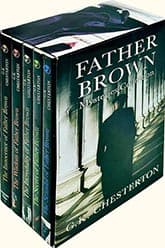 2023 box set
About the books
Author
G.K. Chesterton, England
First publication
1911–1935
Form
Series: five story collections
Genre
Crime, mystery
Writing language
English
• The Innocence of Father Brown (1911)
• The Wisdom of Father Brown (1914)
• The Incredulity of Father Brown (1926)
• The Secret of Father Brown (1927)
• The Scandal of Father Brown (1935)
The constant detective of good and evil
You don't read through G.K. Chesterton's Father Brown books to follow the career, emotional life or intellectual development of the little man at the centre of the stories.
For the character of Father Brown never changes over the course of the five volumes containing stories featuring the elusive priest. For the casual reader he's just a constant figure applying his consistent rationality and understanding of human nature to the solution of befuddling mysteries.
We know little about him as a human being himself at the beginning and little more about him—maybe less—as we progress through the stories. We gather he's a Catholic priest associated with a smalltown English parish early on and transferred to London. This information is sketchy though, as he seems to show up in diverse settings unconnected with any assigned clerical duties. Hints about his age are similarly erratic and the years don't pass reliably between the stories.
To other characters, he can first appear ineffectual and naive about the ways of the world, but they usually learn quickly that he's sharp as a tack with a deep understanding of human nature. He has an uncommon ability to get inside the minds of even the most devious of criminals.
His solution of mysteries depends on this insight into people as much as his Sherlock Holmes-style ratiocination.
This is set in the early stories and varies little over the fifty-odd stories of the Father Brown compilations.
A higher law
The unchangeableness of these characteristics is made clear early on. What drives us through his cases is not to learn more about the man, but it is to see how he sets his logic and insight against the ever-changing varieties of ingenious crimes and deceptive criminals.
It can be startling at times to realize Father Brown is not motivated to punish perpetrators but rather to understand them and ultimately to save their souls. He is not averse to letting them off the hook legally if he feels doing so is following a higher form of justice.
Through the first collection of stories, The Innocence of Father Brown (1911), the investigations become more metaphysical. Some critics have perceived a continuing philosophical development through the remaining volumes. Laird R. Blackwell lists broad concepts corresponding to each of the books as:
1. rigid Ideology and the fixed idea
2. appearance and illusion
3. susceptibility to belief
4. evil of the other
5. confident humility
Personally I can't tell, or perhaps I'm not sensitive enough to perceive, how well this describes a certain progression through the works. But, if it's accurate, it still doesn't indicate transformation of Father Brown's thought or personality through his experiences. Rather it indicates a growing revelation of a morality that is part of the priest all along.
It's notable that the fifth and last phase in this progression is linked with the volume entitled The Scandal of Father Brown (1935), in which the "scandal" is that Father Brown never wavers from his sense of what's right and wrong.
Down to earth
However, this high-brow analysis should not deter you from reading through books if all you want is great detective stories. The best entries feature ingenious mysteries written engagingly and have become classics of the genre. And don't let the talk of religious ideas put you off. Father Brown is a rationalist, eschewing mumbo jumbo and always seeking natural explanations. Frankly, his supposedly Christian-inspired morality does not differ much from the morality of any liberal nonbeliever when applied to fallible human being in earthly situations.
The Innocence of Father Brown is the most popular collection and The Scandal of Father Brown the least, but each of the five collection offers some great stories.
Unless you're a determined collector of early editions, though, you're most likely to encounter the Father Brown stories in various selections spanning the entire canon. These and other editions may be good starting points, purporting to offer a choice of the best of the forty-eight stories from the five first collections, plus three pieces that were never so collected.
The stories I consider essential to any such selection are "The Blue Cross" (the first Father Brown story), "The Queer Feet", "The Invisible Man", "The Dagger with Wings", "The Worst Crime in the World", "The Blast of the Book" and "The Green Man". Some would add the overtly religious "The Hammer of God", the laster "The Quick One", and the bleak "The Sign of the Broken Sword" to that short list .
Father Brown's future
Is Father Brown an eternal character? In The Annotated Innocence of Father Brown (1987), Martin Gardner predicts he fictional exploits of both Sherlock Holmes and Father Brown will continue to be read and relished. in the year to come. However, while Conan Doyle's stature as a writer and thinker will diminish, Chesterton's will grow, he says.
Here's my own guess: both writers will become virtually unknown except as the names associated with their created characters. And Sherlock Holmes will far outlive Father Brown in the general public imagination. Father Brown will live on however, and Chesterton with them (to his chagrin if he could know it), for a smaller group of aficionados who appreciate the greater literary and intellectual complexity of the stories over the morally simpler Sherlockian tales.
As for now, well, we don't live in the far future. And in the present Father Brown remains a great character of popular fiction. Enjoy.
— Eric
Critique • Quotes • Text • Father Brown at the movies
