Robert Burns
Critique • Works • Views and quotes
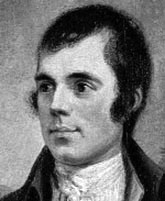
About the author
Born
1759
Died
1796
Forms of writing
Poetry, songs
Writing language
Scots dialect
Literature
• Poems, Chiefly in the Scottish Dialect (1796)
Poems
• To a Mouse (1785)
• Auld Lang Syne (1780)
• Tam O'Shanter (1790)
• Sweet Afton (1791)
• A Red, Red Rose (1794)
• A Man's a Man for a' That (1795)
British Literature
On books, writers and writing
Poets, Madam, of all mankind, feel most forcibly the powers of beauty,—as, if they are really poets of nature's making, their feelings must be finer and their taste more delicate than most of the world. In the cheerful bloom of spring, or the pensive mildness of autumn, the grandeur of summer, or the hoary majesty of winter, the poet feels a charm unknown to the most of his species. Even the sight of a fine flower, or the company of a fine woman (by far the finest part of God's works below), has sensations for the poetic heart that the herd of men are strangers to.
— Letter to Margaret Kennedy, 1785
The novelty of a poet in my obscure situation, without any of those advantages which are reckoned necessary for that character, at least at this time of day, has raised a partial tide of public notice which has borne me to a height, where I am absolutely, feelingly certain, my abilities are inadequate to support me; and too surely do I see that time when the same tide will leave me, and recede, perhaps, as far below the mark of truth. I do not say this in the ridiculous affectation of self-abasement and modesty. I have studied myself, and know what ground I occupy; and however a friend or the world may differ from me in that particular, I stand for my own opinion, in silent resolve, with all the tenaciousness of property.
— Letter to Mrs. Dunlop, 1787
I guess that I shall clear between two and three hundred pounds by my authorship; with that sum I intend, so far as I may be said to have any intention, to return to my old acquaintance, the plough; and, if I can meet with a lease by which I can live, to commence farmer. I do not intend to give up poetry; being bred to labour, secures me independence, and the muses are my chief, sometimes have been my only enjoyment.
— Letter to Mrs. Dunlop, 1787
...rhyme is the coin with which a poet pays his debts of honour or gratitude.
— Letter to Mr. Walker, Blair of Athole, 1787
The earliest composition that I recollect taking pleasure in was "The Vision of Mirza," and a hymn of Addison's, beginning, "How are thy servants blest, O Lord!" I particularly remember one half-stanza which was music to my boyish ear—
"For though on dreadful whirls we hung
High on the broken wave—"
I met with these pieces in Manson's English Collection, one of my school-books. The first two books I ever read in private, and which gave me more pleasure than any two books I ever read since, were the Life of Hannibal, and the History of Sir William Wallace. Hannibal gave my young ideas such a turn, that I used to strut in rapture up and down after the recruiting drum and bag-pipe, and wish myself tall enough to be a soldier; while the story of Wallace poured a Scottish prejudice into my veins which will boil along there, till the flood-gates of life shut in eternal rest.
— Letter to John Moore, 1787
...my success has encouraged such a shoal of ill-spawned monsters to crawl into public notice, under the title of Scottish Poets, that the very term Scottish Poetry borders on the burlesque.
— Letter to Mrs. Dunlop, 1787
Original strokes that strongly depict the human heart, is your and [Henry] Fielding's province, beyond any other novelist I have ever perused. [Samuel] Richardson, indeed, might, perhaps, be excepted; but unhappily, his dramatis personæ are beings of another world; and however they may captivate the unexperienced romantic fancy of a boy or a girl, they will ever, in proportion as we have made human nature our study, dissatisfy our riper years.
— Letter to John Moore, 1791
See also:
Buy the book:
X (Twitter):
